Environment

Service design

Vision and conception workshop

Complex system mapping

Gouvernance for creation

CITEO

Plastic traceability

Strengthening traceability in the plastic recycling chain.

Environment

Service design

Vision and conception workshop

Complex system mapping

Gouvernance for creation

CITEO

Plastic traceability

Strengthening traceability in the plastic recycling chain.

Intro - luxe

Gauche

header-cas

CITEO

Plastic traceability

Strengthening traceability in the plastic recycling chain.

CITEO

Plastic traceability

Strengthening traceability in the plastic recycling chain.

Challenge

Strengthen traceability in a fragmented plastic recycling chain where data, tools and responsibilities differ, creating blind spots that limit operational visibility, quality control and trust between interdependent stakeholders.

Solution

A systemic mapping of material, data and
financial flows that exposes friction points and interdependencies, establishing a shared language and creating actionable foundations for designing concrete, aligned solutions together.
Project
stages

Project stages

Immerse & map out

Set direction

Imagine & test

Shape & refine

Deploy & enhance

Immerse & map out

Set direction

Imagine & test

Shape & refine

Challenge

Challenge

Strengthening traceability in the plastic recycling chain.
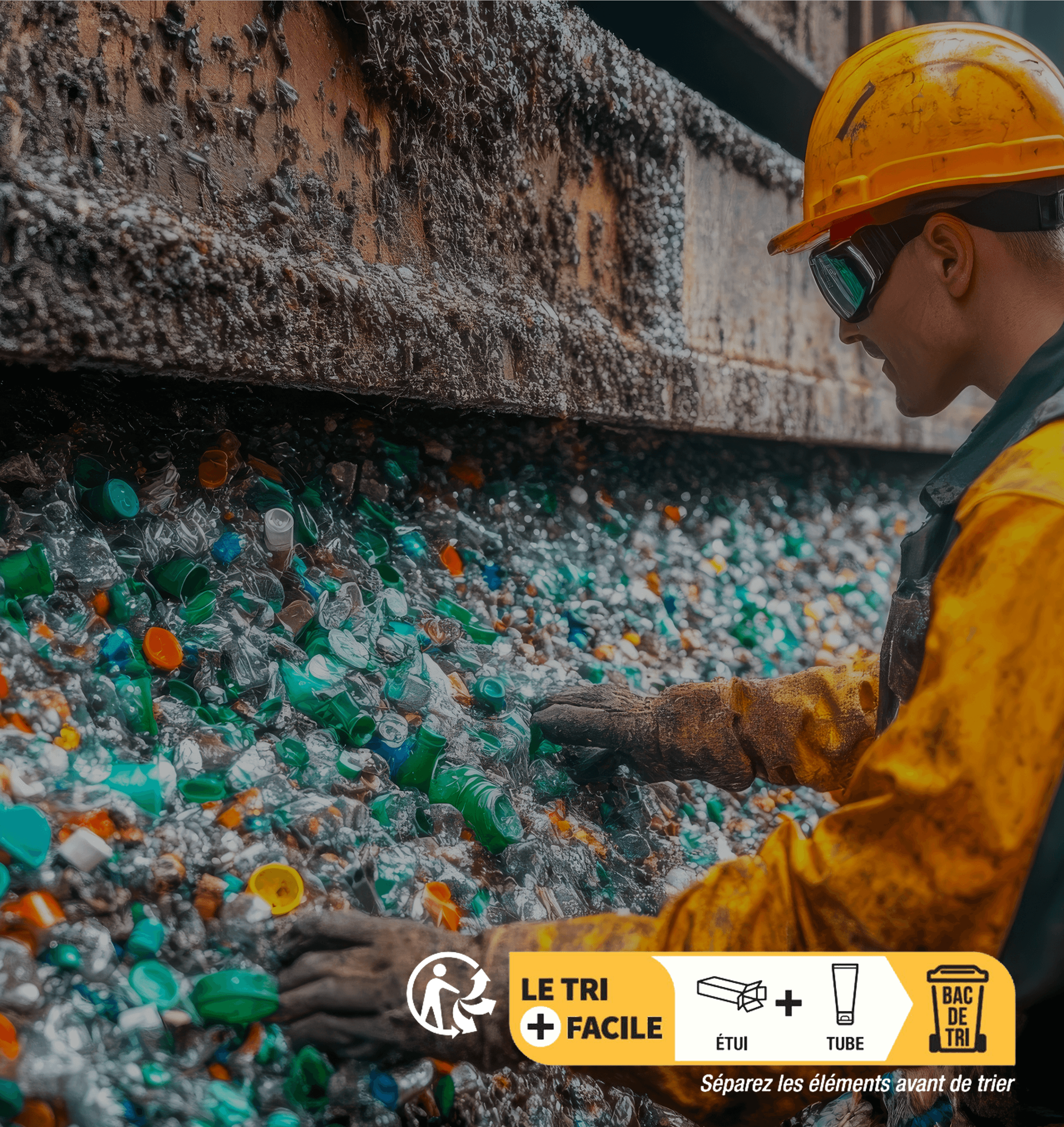
In 2020, CITEO, the state-approved eco-organization responsible for organizing and financing the collection, sorting, and recycling of household packaging, set out to strengthen traceability in the plastic packaging recycling chain. Every actor in the system, from producers and municipalities to sorting centers, recyclers, packaging manufacturers, and control bodies, uses their own tools
and practices. Traceability relies mainly on administrative documents, which are insufficient to provide a systemic view, support coordination, or build genuine trust.
In this complex context, how can a shared framework be created, where data becomes a driver of cooperation rather than a bureaucratic burden?
CITEO commissioned SOUFFL and Veltys, two entities within
the Kéa group with complementary expertise, SOUFFL for field exploration and systemic design, Veltys for modeling and data analysis, to identify the obstacles, map the value chain, and lay the foundations for strengthened traceability across the entire system.


In 2020, CITEO, the state-approved eco-organization responsible for organizing and financing the collection, sorting, and recycling of household packaging, set out to strengthen traceability in the plastic packaging recycling chain. Every actor in the system, from producers and municipalities to sorting centers, recyclers, packaging manufacturers, and control bodies, uses their own tools and practices. Traceability relies mainly on administrative documents, which are insufficient to provide a systemic view, support coordination, or build genuine trust.
In this complex context, how can a shared framework be created, where data becomes a driver of cooperation rather than a bureaucratic burden?
CITEO commissioned SOUFFL and Veltys, two entities within the Kéa group with complementary expertise, SOUFFL for field exploration and systemic design, Veltys for modeling and data analysis, to identify the obstacles, map the value chain, and lay the foundations for strengthened traceability across the entire system.

Immersion

Immersion

Understanding a fragmented yet interdependent value chain.
The team conducted around thirty interviews with municipalities, sorting centers, recyclers, packaging producers, retailers, consulting firms, and certification bodies. The field immersion revealed a value chain that is essential to the circular economy, yet highly fragmented. Local practices differ, quality thresholds vary, tools are inconsistent, and the work is demanding but often undervalued. For many stakeholders, traceability is reduced to a set of documents to be checked, seen as an administrative burden with no operational value. Data does not circulate effectively and does not reflect the real flow of materials or the successive interventions of the actors. This makes it difficult to assess quality or identify material losses within a bale. Everyone acts within their own scope, without an overall view and without a real understanding of each other’s roles.
The study highlighted a major blind spot: each local decision directly affects other parts of the chain, yet this interdependence remained invisible. By making these links understandable and shared, the work initiated a first dynamic of trust and established a common language.

The team conducted around thirty interviews with municipalities, sorting centers, recyclers, packaging producers, retailers, consulting firms, and certification bodies. The field immersion revealed a value chain that is essential to the circular economy, yet highly fragmented. Local practices differ, quality thresholds vary, tools are inconsistent, and the work is demanding but often undervalued.
For many stakeholders, traceability is reduced to a set of documents to be checked, seen as an administrative burden with no operational value. Data does not circulate effectively and does not reflect the real flow of materials or the successive interventions of the actors. This makes it difficult to assess quality or identify material losses within a bale. Everyone acts within their own scope, without an overall view and without a real understanding of each other’s roles.
The study highlighted a major blind spot: each local decision directly affects other parts of the chain, yet this interdependence remained invisible. By making these links understandable and shared, the work initiated a first dynamic of trust and established a common language.

Mapping the ecosystem

Mapping the ecosystem

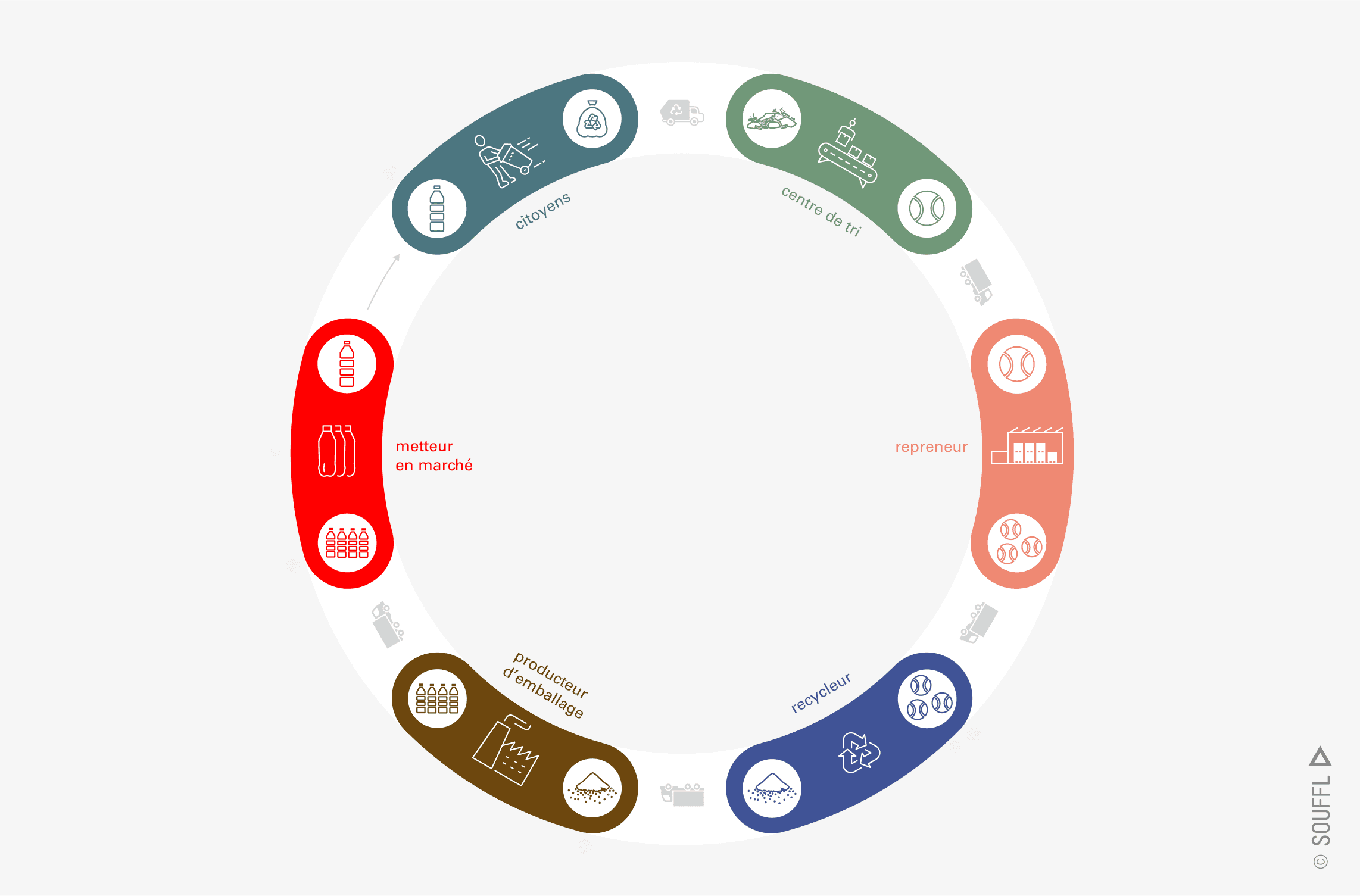
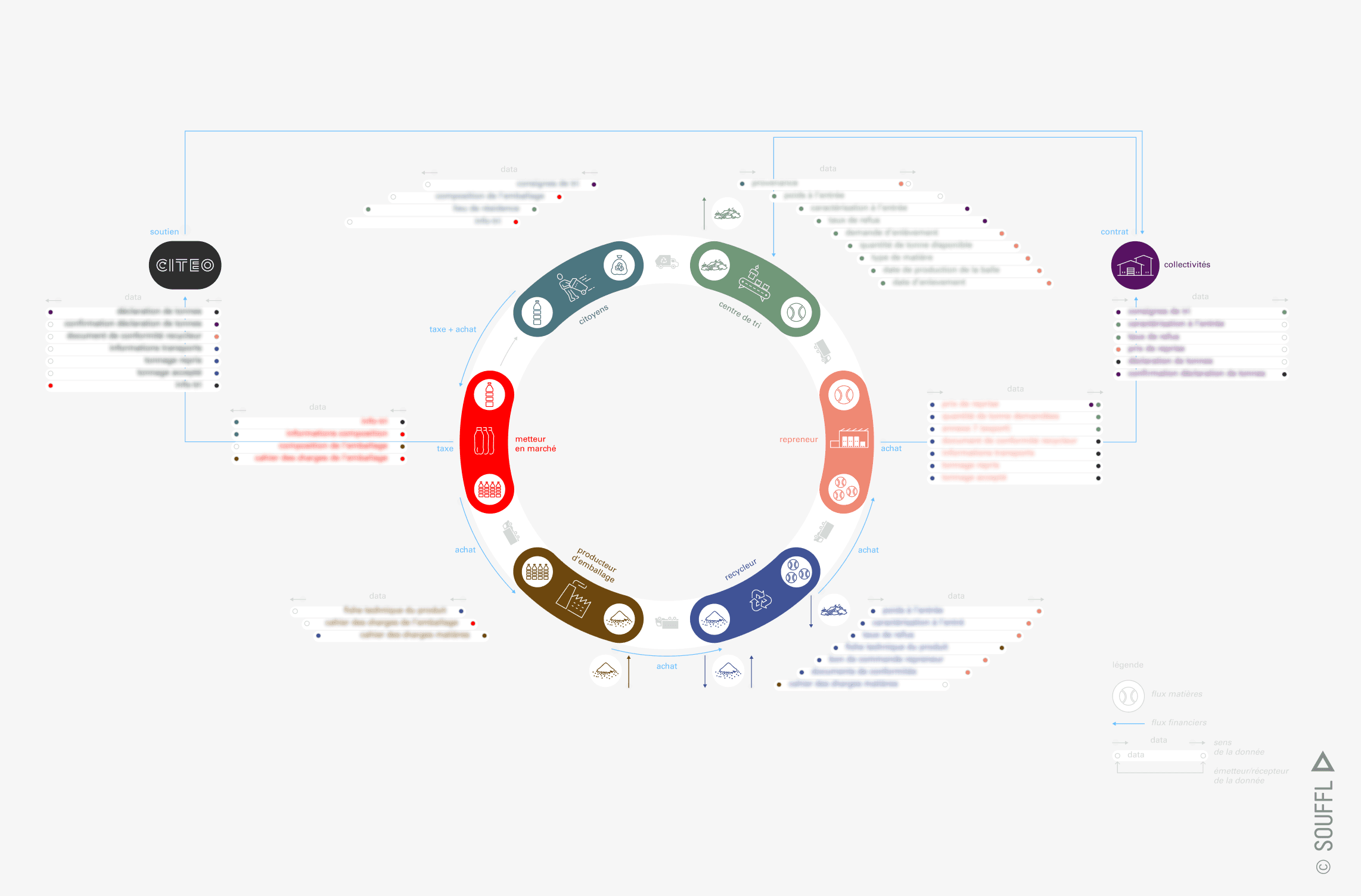
Mapping the wheel of flows.

Based on 400 verbatims and 120 insights, we built a structured mapping around three flows: material, data, and finances. The wheel of flows reveals a major gap: material moves linearly, while information follows fragmented trajectories that depend on contracts, tools, and local organizations.
This systemic representation exposes the main friction points: unstable quality, unclear responsibilities, heterogeneous practices, and limited visibility of how material is reintroduced into the recycling loop. It also highlights the key levers: making data more reliable and fluid, harmonizing practices, and stabilizing quality. The mapping becomes a shared reference point with a clear, previously missing language. It is a tool that provides perspective, enabling everyone to understand the entire chain by making visible the interactions and interdependencies that truly structure the sector.
Collective work

Collective work

A collective Do Tank.

Building on this work, CITEO, Veltys and SOUFFL organized a Do Tank bringing together all stakeholders in the chain.
The various actors worked collectively on the entire cycle, beyond their usual operational boundaries.
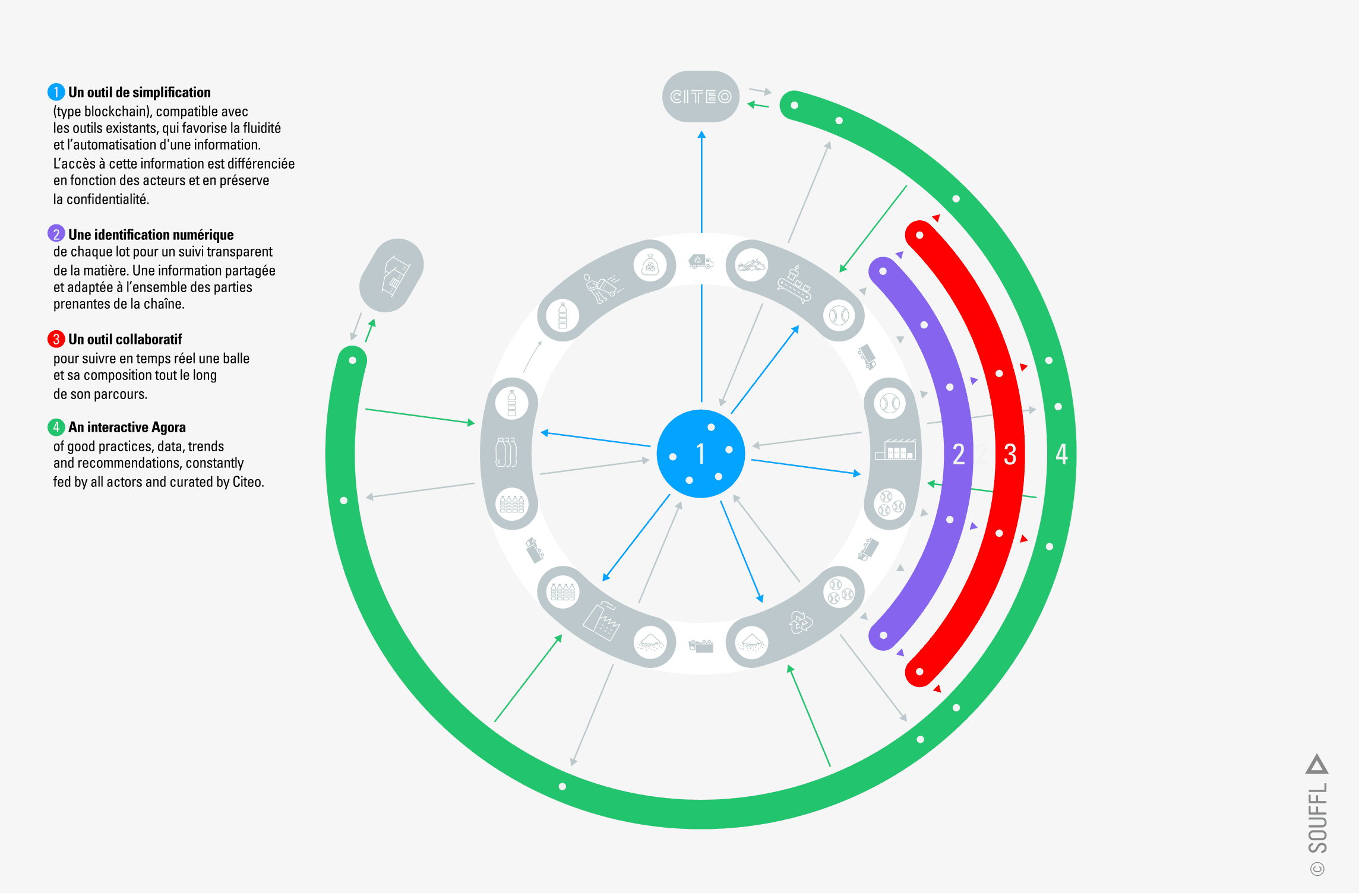
Four structuring solutions emerged from the workshops:
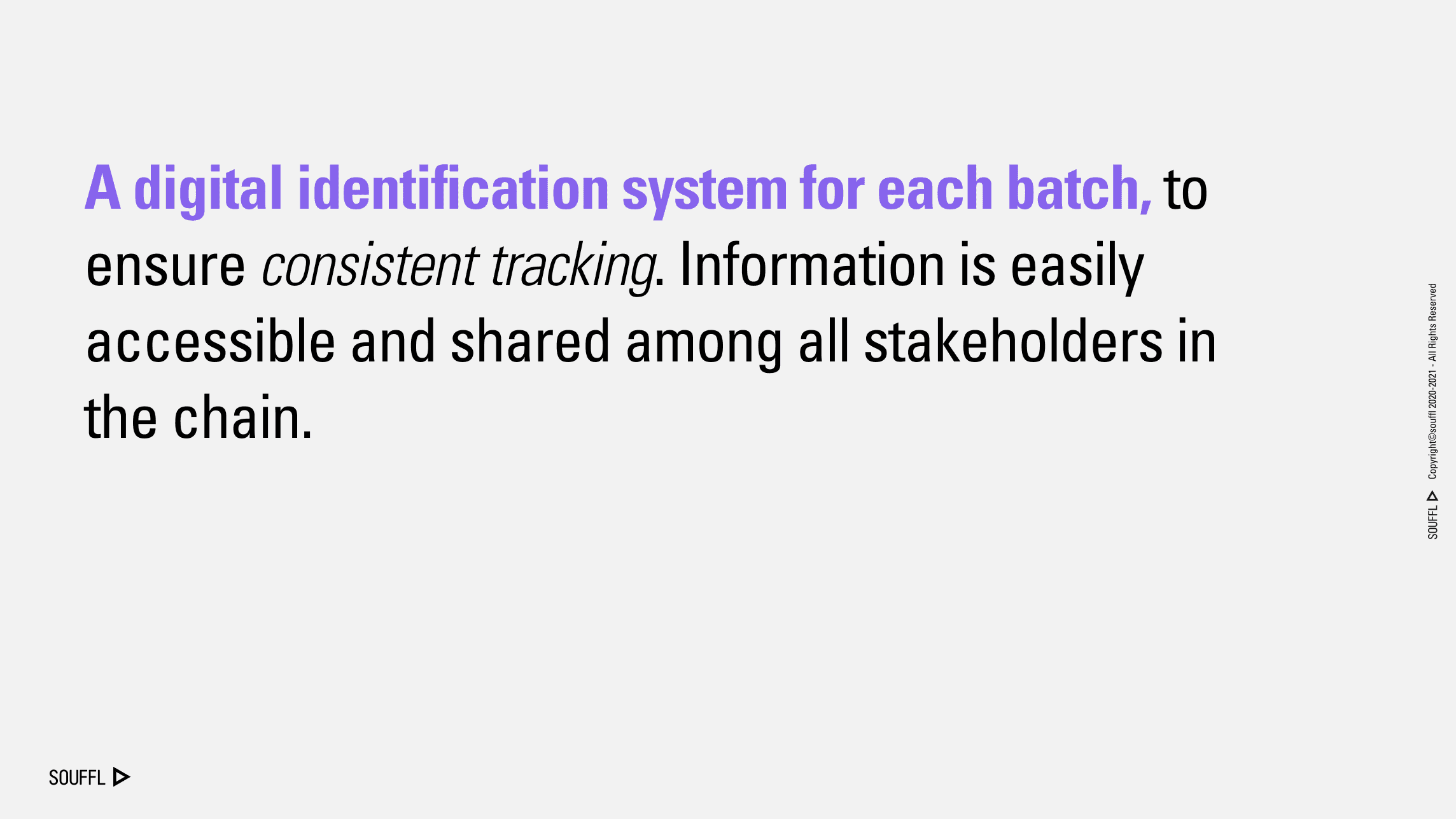
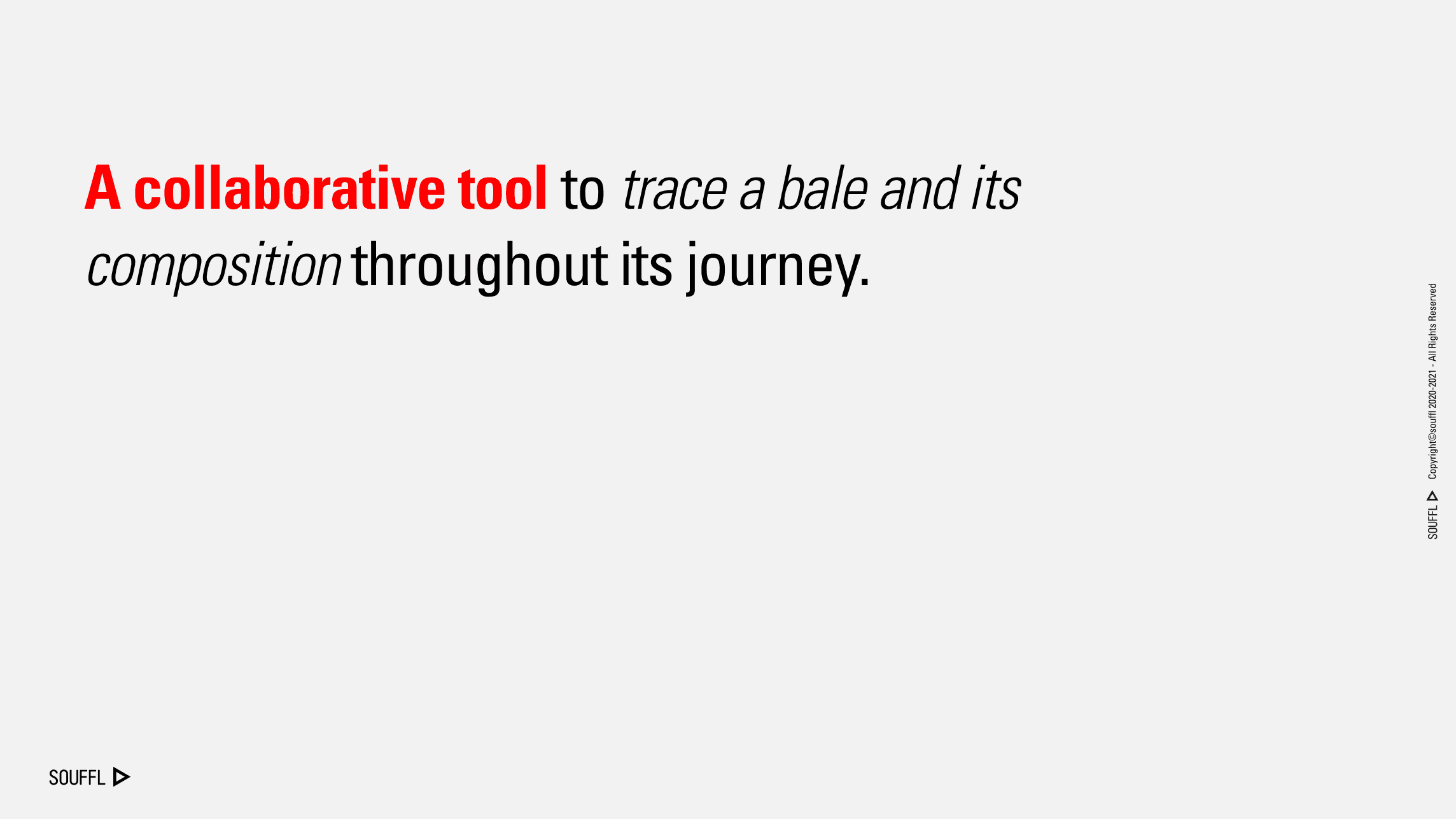
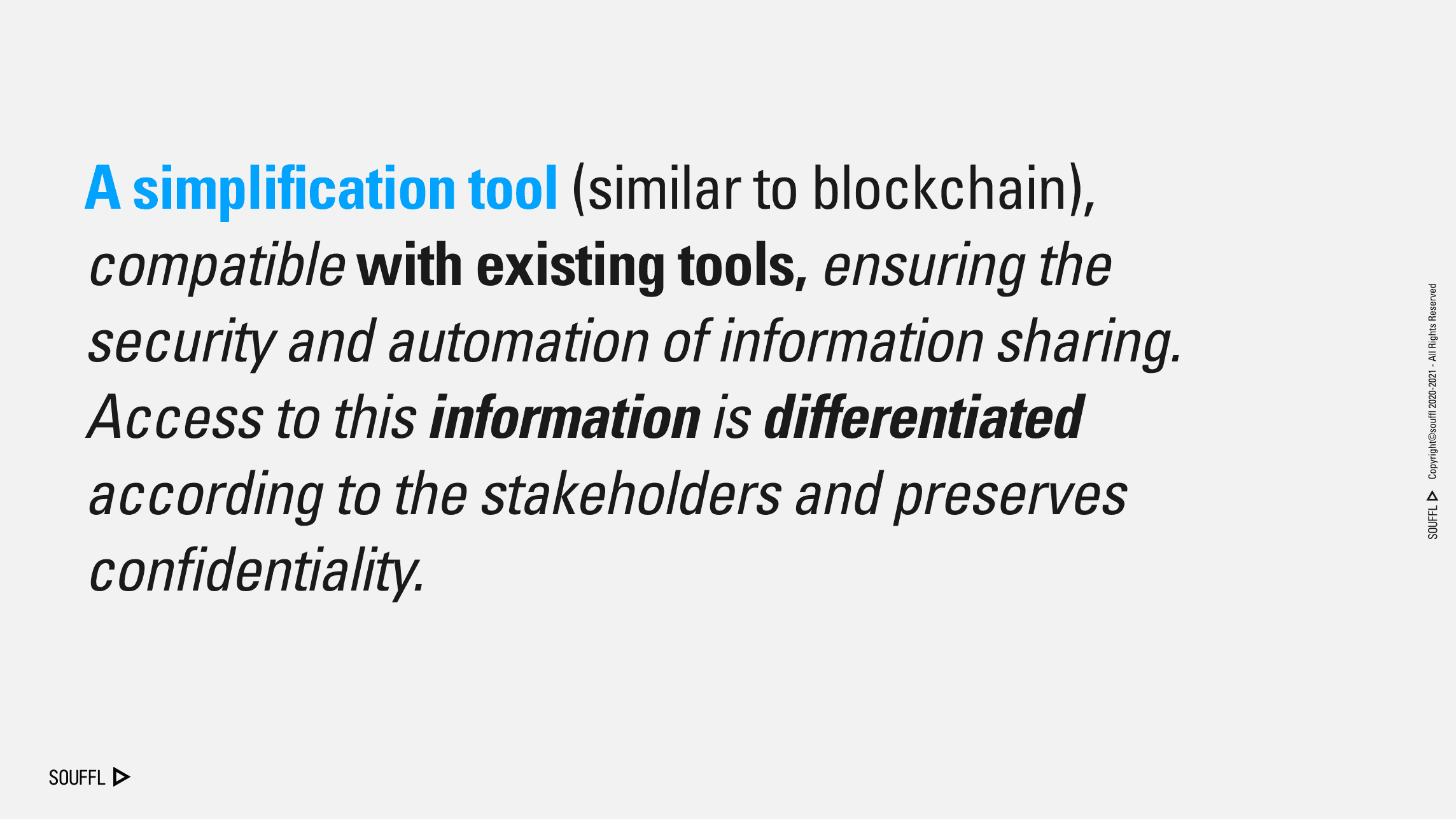
a blockchain-style tool to secure and automate information sharing, a digital identification system for batches to ensure consistent tracking, a collaborative tool allowing the traceability of waste bales and their composition throughout their journey, and an interactive Agora aggregating data, best practices, and emerging trends, facilitated by CITEO.
These directions lay the foundations for a traceability framework designed to strengthen cooperation and establish a shared base of trust.
Result

Result

Enabling a lasting cooperation.

The project enables CITEO to gain a complete systemic understanding of the value chain and a new ability to bring stakeholders together in a lasting way. The case demonstrates how systemic design can realign a complex ecosystem, create a shared language, and establish the conditions for sustainable cooperation. The approach developed with CITEO can now be applied in other sectors facing similar challenges: construction materials, concrete, textiles, or any field that requires reliable, shared, and value-generating traceability.


Need to map out a complex ecosystem for trust, traceability and performance ?
Let’s do it !

Need to map out a complex ecosystem
for trust, traceability and performance ?
Let’s do it !

New business inquiries

New business inquiries

If you have ideas for your brand, your business, or the world at large, we’re here to listen and collaborate. We can design a more human future together.

If you have ideas for your brand, your business,
or the world at large, we’re here to listen and collaborate.
We can design
a more human future together.